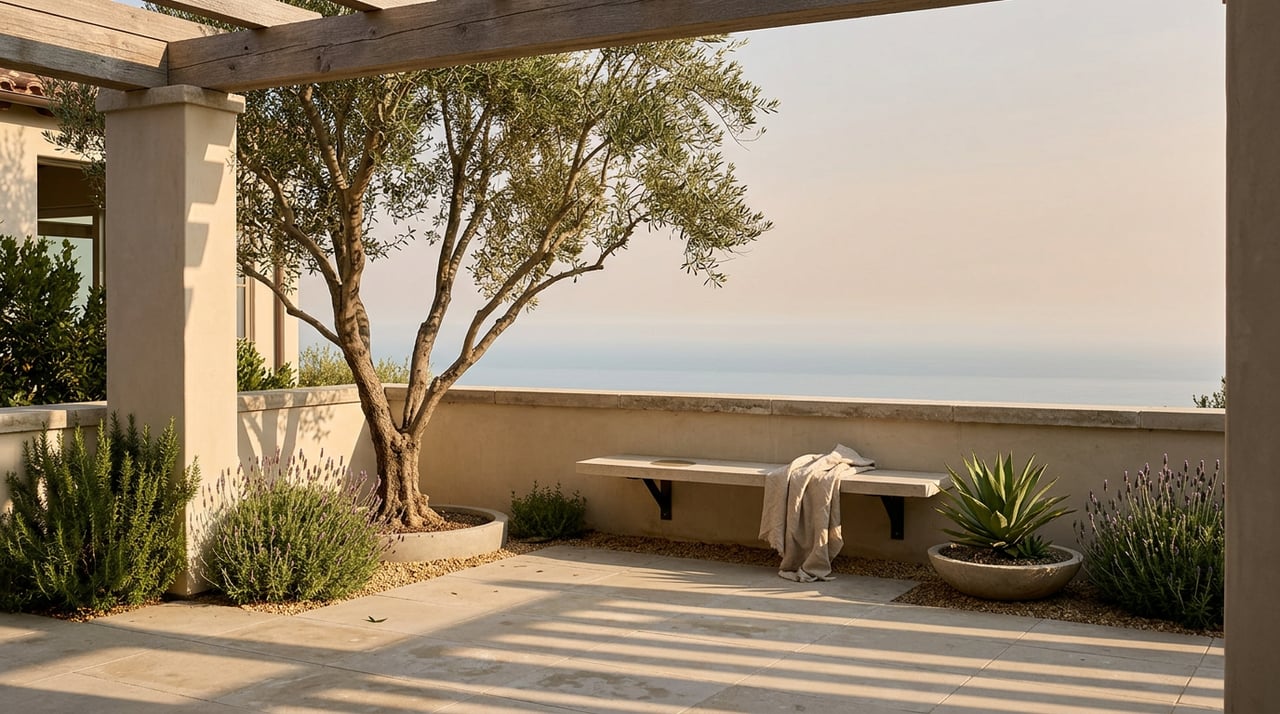
The Laguna Beach Ocean View You're Paying For Might Not Be Yours to Keep
August 20, 2026
August 20, 2026
In the summer of 2015, Roxane and Robert Simon sat across a folding table from their neighbor Roy Henderson and a five-member committee whose entire job was to decide whether an ash tree had stolen their ocean view. The Simons had bought their Pinecrest Drive home in 2009 and documented the view in February 2010: open water, Catalina Island on a clear day. Six years later, Henderson's tree had grown enough to block it. Mediation between the two households had already failed. So the dispute moved to Laguna Beach's View Restoration Committee, which ruled that the Simons had a right to that view back, ordered a specific tree swap, and required Henderson to keep his replacement vegetation trimmed below the height of the Simons' railing going forward. It was the first case the newly formed committee ever heard.
That case is worth knowing before you tour a single view home in Laguna Beach, because it exposes something the listing sheet never tells you: the ocean view you're touring isn't a fixed feature of the property. It's a legal claim with a start date, and that date belongs to whoever owns the home right now, not to you.
Laguna Beach's View Preservation and Restoration Ordinance, codified as Chapter 12.16 of the municipal code, sets a rule most buyers never think to ask about. A homeowner's protected view is defined as whatever existed on their date of acquisition, or November 4, 2003, whichever is earlier. Not the view today. Not the view when a tree was planted. The view on the day the current owner's name went on title.
That means the panoramic ocean view you're standing in front of during a showing carries an invisible asterisk. If the sellers bought in 1998, their legal baseline is the 1998 view. If they bought last year, their baseline is whatever existed last year, which might already be partially grown over. When you close, you don't inherit some universal right to "an ocean view." You inherit the seller's specific baseline, whatever it happens to be, unless a separate legal step was taken to document and transfer that view right clearly.
This is the piece that gets flattened every time someone quotes a median price. Laguna Beach's median sale price sat at $2.75 million in March 2026, and buyers chasing view premiums are often paying for scenery that hasn't been legally locked down at all.
Picture two listings a few blocks apart. Both show the same stretch of coastline from the primary bedroom window. Both are priced the same. On paper, identical view homes.
One seller filed a Record of View years ago under Chapter 12.16.040. That's a separate process from a restoration claim. It doesn't set a height limit on the neighbor's landscaping, but it does create a photographic benchmark the city can point to if that view is ever obstructed later. The other seller never filed anything. Their view exists only because nobody's hedge has grown tall enough yet to test it.
The first home carries a documented view. The second carries a view that is, legally speaking, unproven. If a dispute ever arises, the owner of the second home would need to reconstruct pre-existing conditions from scratch, often years after the fact, using whatever photos happen to exist. The city is explicit that photos from real estate listing sites don't count as evidence in a restoration claim, which means the very images used to sell you the home can't later be used to defend the view it was sold on.
There's a second wrinkle worth knowing if you're the one buying and thinking ahead: under the ordinance, you can only pursue View Restoration first and then later file a View Preservation to protect what's left. If you file Preservation first, you lose the ability to later file a Restoration claim. Order matters, and it's not something a buyer typically learns until they're already the one filing.
Whatever a committee eventually decides, city code is clear that the outcome runs with the land. It binds the claimant and the vegetation owner, along with their heirs and successors. A view fight your seller settled five years ago follows the property to you. So does one they never bothered to start.
If a view has already been obstructed by a neighbor's landscaping, restoring it isn't a phone call to code enforcement. It's a two-phase legal process, and neither phase is fast or cheap.
Phase one is mediation. A claimant has to show a documented pre-existing view, attempt good-faith contact with the vegetation owner, and pay a mediation fee before a neutral third party even sits down with both sides.
Phase two only happens if mediation fails. The claimant then files a formal restoration claim, which goes to a public hearing before the five-member View Restoration Committee. That committee generally meets the second Wednesday of each month at 5 p.m., and as of March 2026 the city was still actively recruiting residents to fill open seats on it, alongside the Parking, Traffic and Circulation Committee. The ordinance isn't a relic. It's a functioning process with a live docket.
Costs have not stayed flat, and they were already climbing within the ordinance's first year:
| Step | What happens | Fee reported in 2015 |
|---|---|---|
| Mediation (Phase 1) | Non-binding attempt to resolve the claim with a neutral third party | $500 minimum |
| Restoration hearing (Phase 2) | Public hearing before the View Restoration Committee | $630, raised to $690 within six months |
| Appeal to city council | Either side disputes the committee's ruling | $2,500 |
That puts the combined minimum to simply get a hearing at roughly $1,130 in the ordinance's first year, before an appeal or a single arborist invoice. And none of this includes the arborist. If the claimant wins, they select a certified professional to perform the trimming or removal, and the vegetation owner covers the difference in cost only if they insist on choosing a different arborist than the claimant did.
There's also a scope limit worth knowing before you assume the ordinance will solve every view problem. The definitions written into Chapter 12.16 all revolve around vegetation: pruning, cutting, changing the water supply, re-grading around root zones. Nothing in the ordinance reaches a neighbor's roofline, addition, or new second story. Those fall under the city's separate zoning and design review framework, where height limits and design review board authority are handled through entirely different sections of the municipal code. A tree can be ordered trimmed. A house generally cannot.
None of this means a Laguna Beach view is a bad investment. Thirteen restoration claims were filed in the ordinance's first several months alone, and two were resolved simply because the vegetation owners voluntarily trimmed once a claim was filed. Most disputes never reach the committee at all. But it does mean the standard question buyers ask, does this home have a view, is the wrong question. The better one is whether that view has ever been tested and whether it's documented.
Before you write an offer on a view property, it's worth asking:
A documented, defensible view corridor is a durable asset. An undocumented one is a bet that nobody's landscaping changes before you decide to sell.
If a neighbor's tree blocks my view after I move in, can I force them to cut it down? Only if the view was documented as pre-existing under your baseline, which is your acquisition date or November 4, 2003, whichever is earlier. If the view was already blocked when you bought, that blocked view is your legal starting point, not the open view you may have seen in old photos.
Does the ordinance cover a neighbor's new addition or a taller fence, not just trees? No. The ordinance's definitions are built entirely around vegetation. Structural changes, including additions, new stories, and height increases, are governed separately through the city's zoning code and design review process.
If I sell my home after winning a view restoration order, does the next owner keep that protection? Yes. City code states that committee decisions run with the land and are binding on both parties' heirs and successors, so a settled view dispute transfers to whoever buys the property next.
A view is one of the biggest reasons people pay a premium in this city, and it deserves the same due diligence as the roof or the foundation. If you're comparing view properties in Laguna Beach and want someone who will actually pull the history on a parcel before you write an offer, Angi Ciccarelli can walk through it with you. Schedule a free consultation.
Stay up to date on the latest real estate trends.
Trust her to bring personal, top-tier real estate service in South Orange County. With her dedication, market expertise, and investor-savvy approach, she guides buyers and sellers carefully and confidently.
South Orange County, CA 92008